Nobody Talks About This Enough
You’re sitting in seat 32A, somewhere over the Atlantic, sipping bad coffee at 35,000 feet. Just a few meters away, a machine the size of a small car is spinning at roughly 15,000 RPM, burning through hundreds of pounds of jet fuel per hour, and doing it so reliably that you haven’t given it a second thought. That’s the jet engine. And honestly, it might be the most impressive piece of engineering most people will ever be within arm’s reach of.
Most passengers treat jet engines like appliances, like a microwave that happens to hurl you across continents. But if you’re into aviation, even casually, understanding how these things actually work changes the way you look at every single flight.
The Core Idea Is Simpler Than You Think
Here’s the thing. At its core, a jet engine is doing one job: taking in air, squeezing it, mixing it with fuel, burning it, and blasting it out the back. Newton’s third law does the rest. Every action has an equal and opposite reaction, so the air shooting backward pushes the aircraft forward. That’s thrust.
The elegant part is how those steps happen in sequence, continuously, thousands of times per second inside a single spinning machine. Let’s walk through it.
Intake
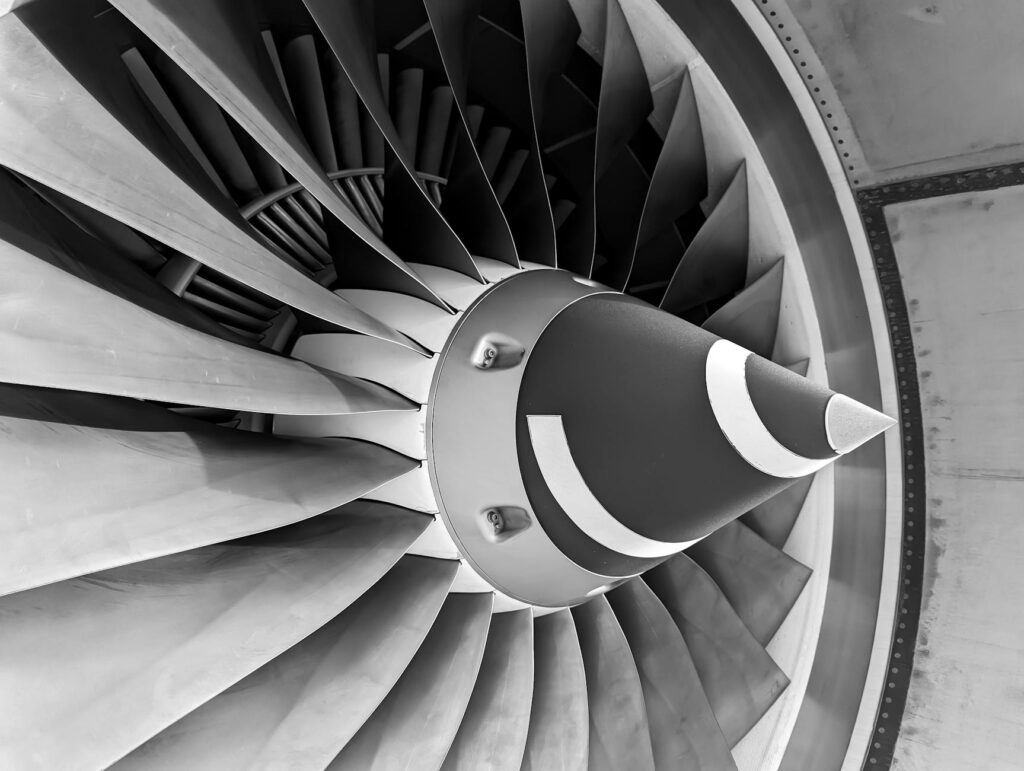
Air enters through the front of the engine. On a modern high-bypass turbofan, which is the type powering most commercial airliners today, you’ll see a massive fan at the front. That fan does two things: it pulls in a huge volume of air, and it splits that air into two paths. A small portion goes into the core of the engine. The rest bypasses the core entirely and gets accelerated out the back, contributing a significant chunk of the total thrust.
On engines like the GE90 used on the Boeing 777, the bypass ratio can be as high as 9:1. That means for every one part of air going through the hot core, nine parts are flowing around it. That’s why modern turbofans are so much quieter and more fuel-efficient than the early jet engines of the 1950s and 60s.
Compression
The air entering the core gets squeezed by a series of rotating compressor stages. Think of them as stacked fans, each one spinning and pushing the air tighter and tighter. By the time the air reaches the combustion chamber, it’s been compressed to pressures that can exceed 40 times atmospheric pressure in some engines. At that point, the air is also very hot, just from being compressed.
Combustion
Fuel, typically Jet-A on commercial flights, is injected into the compressed air and ignited. The temperature in the combustion chamber can reach well over 1,700 degrees Celsius. That’s hotter than the melting point of the nickel alloys used to make the turbine blades right downstream. The only reason those blades survive is a combination of ceramic thermal barrier coatings and tiny internal cooling channels that bleed cool air through the blade itself. It’s genuinely wild engineering.
Turbine and Exhaust
The hot, expanding gases blast through the turbine stages. The turbines extract energy from that flow to power the compressors up front, because the compressors need to keep spinning to keep the whole cycle going. What energy is left after that exits through the nozzle at high velocity. That’s your exhaust, and on a turbofan, it combines with the bypassed fan air to produce the total thrust you feel pushing you back in your seat on takeoff.
Why Are They So Reliable?
This is the part that genuinely impresses me. Jet engines have achieved an almost absurd level of reliability. The overall engine-caused accident rate in commercial aviation is incredibly low, with mechanical failures accounting for a tiny fraction of incidents compared to, say, weather or human factors.
A big reason for that is the concept of redundancy baked into everything. Two engines, dual hydraulic systems, multiple fuel pumps. But the engines themselves are also designed around failure modes. Turbine blades are contained so that if one fails, it doesn’t punch through the engine casing into the fuselage. The FAA mandates Extended-range Twin-engine Operational Performance Standards, better known as ETOPS, which require engines to be certified for operations up to 180 minutes or more from a diversion airport. That certification involves thousands of hours of testing and a track record in service.
What’s Changing in Jet Engine Technology
The next big leap is already happening. Geared turbofan engines, like the Pratt and Whitney PW1000G series now on the Airbus A320neo family, add a reduction gearbox between the fan and the low-pressure turbine. This lets each component spin at its own optimal speed rather than being locked together. The result is a claimed 16% fuel burn improvement over the previous generation. That’s enormous when you’re burning thousands of gallons per flight.
Further out, you’ve got hybrid-electric propulsion being explored for regional aircraft, and sustainable aviation fuel blends that can run in existing engines with minimal modification. The core thermodynamic cycle isn’t going away anytime soon, but the engineering around it is evolving fast.
In my view, the jet engine is one of those inventions that deserves a lot more appreciation than it gets. It’s not glamorous in the way that a sleek cockpit or a supersonic aircraft is. But every time you land safely after a seven-hour flight, that engine quietly did its job about half a billion times over. Pretty remarkable for something most people walk right past.
If you’re planning flights and want to estimate fuel burn for different aircraft types, our Fuel Burn Estimator makes it easy, with built-in aircraft presets and support for both gallons and kilograms. Try it free. And if you want to quickly calculate flight times between airports, the Flight Time Calculator handles great-circle distances and gives you estimated enroute times in seconds.