SkyToolbox

How Jet Engines Actually Work

How Jet Engines Actually Work (And Why It’s So Clever)

Picture of Mohib Memon
Mohib Memon

Founder SkyToolbox

The Most Powerful Thing You’ve Ever Ignored

You walk past them at the gate, maybe glance up at the nacelle while boarding, and then forget they exist for the next six hours. Jet engines are arguably the most impressive machines ever built, and most people treat them like background furniture. Honestly, that’s a shame, because once you understand what’s happening inside one of those things, you’ll never look at a widebody the same way again.

Let’s break it down in plain language, no engineering degree required.

The Core Idea: Suck, Squeeze, Bang, Blow

That’s actually the informal nickname engineers use for the four stages of a gas turbine cycle. It’s a bit crude, but it’s accurate. Air comes in the front, gets compressed, fuel gets added and ignited, and the resulting hot gas blasts out the back. The reaction to that rearward thrust is what pushes the aircraft forward. Newton’s third law, working overtime at 35,000 feet.

The beauty is in how elegantly each stage feeds into the next. The engine is essentially a carefully managed controlled explosion that never stops. From the moment the crew advances the thrust levers on takeoff roll to the moment they pull them back on final, that combustion process is running continuously. No spark plugs cycling, no pistons reversing direction. Just a smooth, unrelenting flow of energy.

Breaking Down Each Stage

The Fan and Compressor

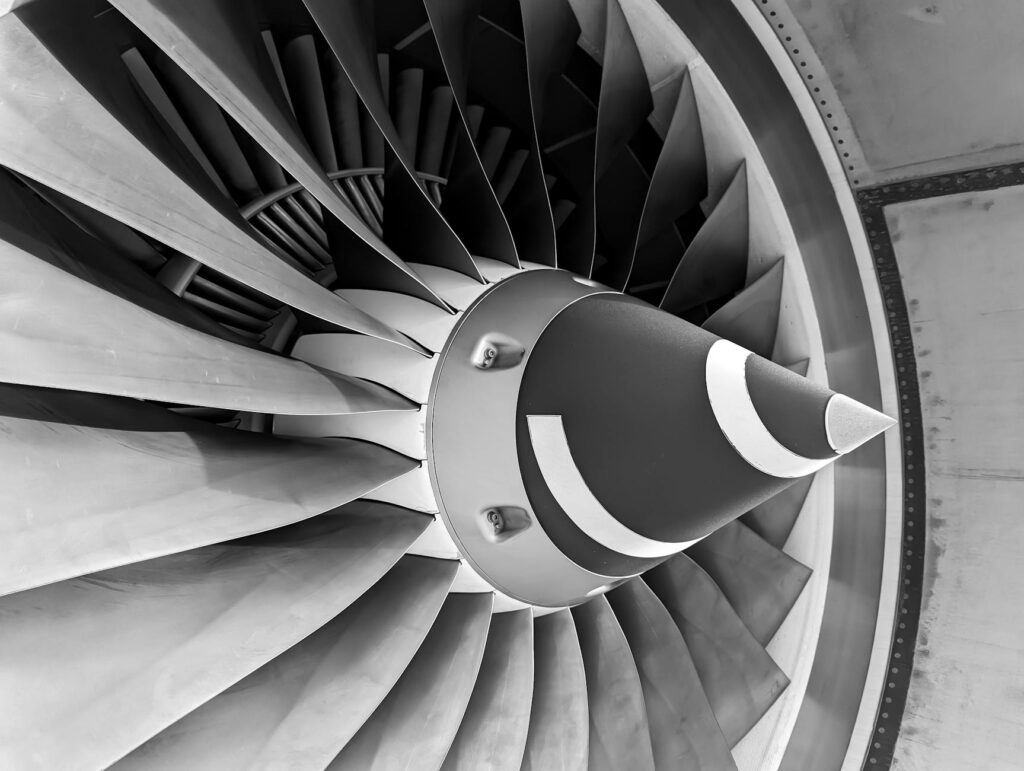
Walk up to a modern high-bypass turbofan, like a CFM LEAP or a Rolls-Royce Trent, and the first thing you see is that enormous fan up front. On something like the GE90 powering the Boeing 777, that fan is over 3 meters in diameter. It’s not just for show. That fan moves a massive volume of air, but most of it actually bypasses the core of the engine entirely. That bypass air is what generates the majority of thrust in a modern turbofan, and it’s also why these engines are so much quieter and more fuel-efficient than the early jets from the 1950s.

The air that does enter the core hits the compressor stages next. Rows of spinning blades force the air into a progressively smaller space, raising its pressure dramatically. We’re talking pressure ratios of 40:1 or higher in modern engines. The air gets hot just from being compressed, before any fuel is even added.

Combustion

Compressed air enters the combustion chamber, fuel is injected, and it ignites. The temperatures here are extraordinary. Combustion gases can exceed 1,700 degrees Celsius, which is actually hotter than the melting point of the nickel alloys used to make the turbine blades downstream. The only reason those blades survive is because they’re hollow, with microscopic cooling holes that bleed air across their surfaces to keep them from melting. That engineering solution alone is worth admiring for a moment.

The Turbine and Exhaust

Hot gas exits the combustor and drives the turbine stages, which extract energy from the flow to spin the compressor and the fan up front. What’s left exits through the nozzle as exhaust, contributing additional thrust. The whole system is a carefully balanced loop, each part depending on the others to function.

Turbofan vs. Turbojet: Why It Matters

Early jets like those on the de Havilland Comet were pure turbojets. All the thrust came from the exhaust jet. Efficient at high speeds and high altitudes, but noisy and thirsty at lower speeds. The turbofan solved this by adding that big bypass fan, which moves a large mass of air at lower velocity. Physically, that’s more efficient than accelerating a small mass of air to extreme velocity, which is exactly what the Brayton cycle efficiency numbers tell you if you dig into the thermodynamics.

Modern high-bypass turbofans have bypass ratios around 10:1 or even 12:1 on the latest generation engines. That means for every kilogram of air going through the core, twelve kilograms go around it. That’s why a 787 can cross the Pacific on far less fuel than a 707 could ever dream of.

The Part Most People Miss

In my view, the most underrated aspect of jet engine design is the materials science. The turbine blades at the heart of the hot section are single-crystal metal castings, grown as one continuous grain structure to resist the creep and fatigue that would destroy a conventional alloy. Each blade is individually precision-cast, inspected, and certified. The tolerances are tighter than a Swiss watch, operating in an environment closer to the surface of the sun than your kitchen oven.

That’s not hyperbole. That’s engineering reality. And it’s why jet engines have become so reliable that a twin-engine commercial aircraft can fly 180-minute ETOPS routes over open ocean, trusting that each engine will keep running without hesitation.

Okay, Now the Fun Part

Understanding engine performance also means understanding how fuel burn, airspeed, and distance all connect in real flight planning. If you’re a student pilot or an enthusiast who wants to see how that plays out in numbers, we’ve got a couple of tools that make it easy.

Our Fuel Burn Estimator lets you estimate trip fuel, reserve, and taxi fuel for different aircraft types, in gallons or kilograms. Try it free. And if you want to figure out actual flight times and distances between airports, the Flight Time Calculator handles great-circle distance and estimated flight time for any two airports worldwide. Also free. Give them a go the next time you’re nerding out over a route.

Share