What’s Actually Happening Inside That Engine?
Stand close enough to a departing widebody and you feel it before you hear it. That wall of heat and sound hits you in the chest, and somewhere in the back of your mind you’re aware that what’s producing it is one of the most precisely engineered machines ever built. Jet engines are genuinely remarkable, and honestly, most people including plenty of aviation students, have only a fuzzy idea of how they actually work.
Let’s fix that.
The Core Idea: Suck, Squeeze, Bang, Blow
Old-school mechanic slang, but it nails the four-stroke idea, and the same basic logic applies to a jet engine. Air comes in the front, gets compressed, fuel gets added and ignited, and the exhaust blasts out the back. Newton’s third law does the rest. For every action, equal and opposite reaction. The engine pushes air backward, the aircraft gets pushed forward. Simple in concept, extraordinarily complex in execution.
A modern high-bypass turbofan, which is what you’ll find hanging under the wings of most commercial jets today, takes that basic idea and layers in some serious engineering sophistication. The “high-bypass” part is key. On something like a CFM LEAP or a Rolls-Royce Trent XWB, the large fan at the front moves a massive amount of air around the core of the engine, not through it. That bypassed air produces the majority of the thrust while also acting as a sort of acoustic blanket around the hot core exhaust. It’s why modern jets are so much quieter than the shrieking turbojets of the 1960s.
Breaking Down the Stages
Here’s where it gets interesting. A turbofan isn’t just one thing happening. It’s a series of carefully choreographed stages working in sequence, each one depending on the last.
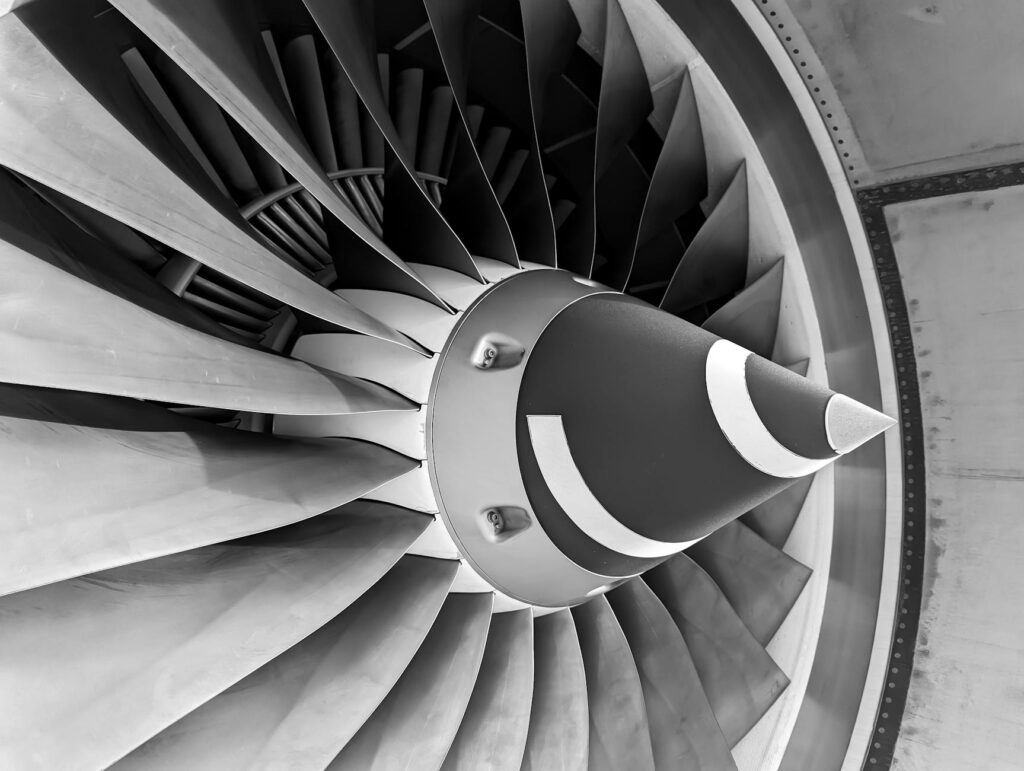
First, the fan. That massive spinning disc you see from the gate. On a GE9X (the engine powering the 777X), the fan diameter is about 134 inches. It pulls in an enormous volume of air and splits it: a small portion goes into the engine core, and the vast majority goes around it.
The air entering the core hits the compressor stages next. These are rows of spinning blades, alternating with fixed stator vanes, that progressively squeeze the incoming air to an almost unbelievable degree. Modern engines achieve compression ratios above 50:1. To put that in perspective, the air entering the combustion chamber is over fifty times more dense than the air at the intake. Squeezing gas like that raises its temperature dramatically, which is exactly what you want before you add fuel.
Then comes the combustion chamber. Fuel, typically Jet-A, gets atomized and mixed with the compressed air. Ignition happens, temperatures spike to somewhere around 1,700 degrees Celsius or more, and the expanding gases rush toward the back of the engine at serious velocity. The turbine blades back there are operating in conditions that would destroy most metals, which is why engine manufacturers spend enormous resources on exotic nickel superalloys and internal cooling channels machined into each blade at a microscopic level. Some turbine blades are actually hollow, with cool air flowing through tiny internal passages to keep them from melting.
Finally, those hot gases exit through the nozzle and produce thrust. The turbine also extracts energy from the exhaust flow to keep the compressor and fan spinning. It’s a self-sustaining loop once it gets going, which is a beautiful piece of engineering when you stop and think about it.
Why Bypass Ratio Matters So Much
In my view, bypass ratio is one of the most underappreciated concepts in commercial aviation. A higher bypass ratio generally means better fuel efficiency and lower noise. Early turbojets had a bypass ratio of essentially zero. The first high-bypass engines in the late 1960s, like the JT9D on the original 747, were around 5:1. Today’s GE9X pushes a bypass ratio of about 10:1. That leap in efficiency is a big part of why a modern 787 burns roughly 20 to 25 percent less fuel per seat than the 767 it was designed to replace.
For student pilots and aviation enthusiasts, understanding bypass ratio also helps explain why turboprops and turbofans exist for different missions. A turboprop is basically a turbofan taken to the extreme, where almost all the energy goes into spinning a propeller rather than producing jet exhaust. It’s incredibly efficient at lower altitudes and speeds, which is why you see them on regional commuters and bush planes rather than on anything doing Mach 0.85 at flight level 390.
The Part Most People Never Think About
Let’s be honest, most of the conversation about jet engines focuses on thrust and fuel burn. But the structural engineering side of this is just as mind-bending. A single turbine blade in a high-pressure stage experiences centrifugal loads equivalent to supporting the weight of a double-decker bus. While sitting in a river of fire. At cruise altitude. For hours at a time.
Engine certification processes require manufacturers to demonstrate that the engine can contain a blade failure without throwing debris through the fuselage. That’s a real test. They literally fire blades into running engines. The containment ring around the engine core exists specifically for that scenario.
Next time you’re sitting in a window seat over the wing, take a second look at that engine pod. What looks like a simple tube is actually doing something extraordinarily precise, thousands of times per minute, in conditions that push the absolute limits of what materials can survive.
If you’re a student pilot doing flight planning around aircraft performance and fuel, we’ve got tools that can help with the practical side of all this. The Fuel Burn Estimator lets you calculate trip fuel, reserve, and taxi fuel for different aircraft types, and the Flight Time Calculator handles great-circle distance and estimated flight time between any two airports. Both are free to use.